Chicago Back-to-School Guide: Self-Serve Laundromats, Wash, Dry, Fold and Laundry Delivery Options for Students
It’s two or three weeks into the semester. An exam is tomorrow, the hamper is full, you’re out of clean clothes and the person who used to make this problem disappear is a long drive away. What’s a busy Windy City student to do?
If your building has no in-unit laundry, you have three real options: a self-serve laundromat, a wash and fold laundry service or laundry pickup and delivery. Self-serve laundromats are the fallback most students already know, familiar and available in nearly every Chicago neighborhood. The other two exist for exactly the weeks when a laundromat trip doesn’t fit.
There’s no single right way to tackle this problem. Instead, it comes down to knowing what’s out there, what each option costs in time and money and picking what best fits your needs this week.
Laundry Basics for Students and Renters
If you didn’t do your own laundry much before college, you’re in good company. Here’s the short version of what you’re working with.
Shared building machines: Many dorms and apartment buildings have a laundry room somewhere on-site, often paid by app or card. It’s convenient in theory, but shared machines mean shared schedules. Sunday night, when the whole building remembers at once, and the night before a big exam are the busiest times, so it’s worth scouting a few off-peak hours early in the semester. Two unwritten rules keep the peace:
- Set a timer, so your finished load isn’t sitting in the washer while someone waits.
- Never leave clothes in a machine overnight.
Self-serve laundromats: If a building doesn’t have machines, or the wait for the one working washer isn’t worth it, self-serve laundromats are the next option. Speed Queen® has four Chicago-area locations on the Northwest and Southwest sides, with early-morning and late-night hours for people coming from class or work. You bring the laundry, pick a machine sized for your load, run it yourself and walk out with a finished load. Attendants are often on hand, and they’ve walked plenty of first-timers through a commercial front-loader without judgment. The Speed Queen app also lets you pay from your phone and get an alert when the cycle finishes, so you don’t have to hover next to a machine and wait.
A few basics worth knowing before your first load:
- Sort by color and fabric type before you leave, not once you’re standing at the machine.
- Front-load washers typically need less detergent than top-load machines, so check the amount on the bottle rather than eyeballing it.
- Bedding and towels usually need a larger machine than a regular load of clothes. Overstuffing a small washer is the usual reason a load comes out damp, wrinkled and not quite clean.
- A mesh bag for delicates and a separate bag for whites can save a lot of sorting time.
- Wash new towels and dark jeans on their own the first time, so dye doesn’t bleed into other items.
- Check pockets before washing. Pens and gum wrappers do not come out clean.
- Read care tags, especially the first few times, until sorting becomes second nature.
- Keep a small supply of detergent and dryer sheets on hand so laundry day doesn’t turn into a supply run first.
- Pick a laundry day and stick to it, rather than waiting until the hamper forces the issue.
- If using a service, note any special instructions (like fragrance-free detergent) ahead of time rather than after the fact.
The Options: What’s Actually Available
That to-do list is often fuller than it looks. In fact, three out of four students work part-time, averaging 16 hours a week, on top of roughly nine hours of class-related work and five more on campus activities. That leaves little time for laundry. Speed Queen has built laundry equipment since 1908 and runs four stores in Chicago, so we’ve watched a lot of semesters play out. The pattern is consistent: the plan that works in September rarely survives midterms, let alone the first snow. Your decision really comes down to time, budget and how much you want laundry on your weekly to-do list.
The easy way to compare? Think in pounds. A typical week of laundry for one person weighs about 10 to 15 pounds. That number tells you what each option really costs.
- Wash and fold: Multiply your pounds by the posted per-pound rate. That’s the whole cost, and it buys back your evening.
- Self-serve: What the machines cost, plus about 90 minutes of your night sorting, waiting and folding on a warm table.
If that 90 minutes is worth more to you than the price difference this week, use the service. If it isn’t, run the machines yourself. Midterms week and a slow Sunday in October will give you different answers, and both are right.
Wash, Dry, Fold Service
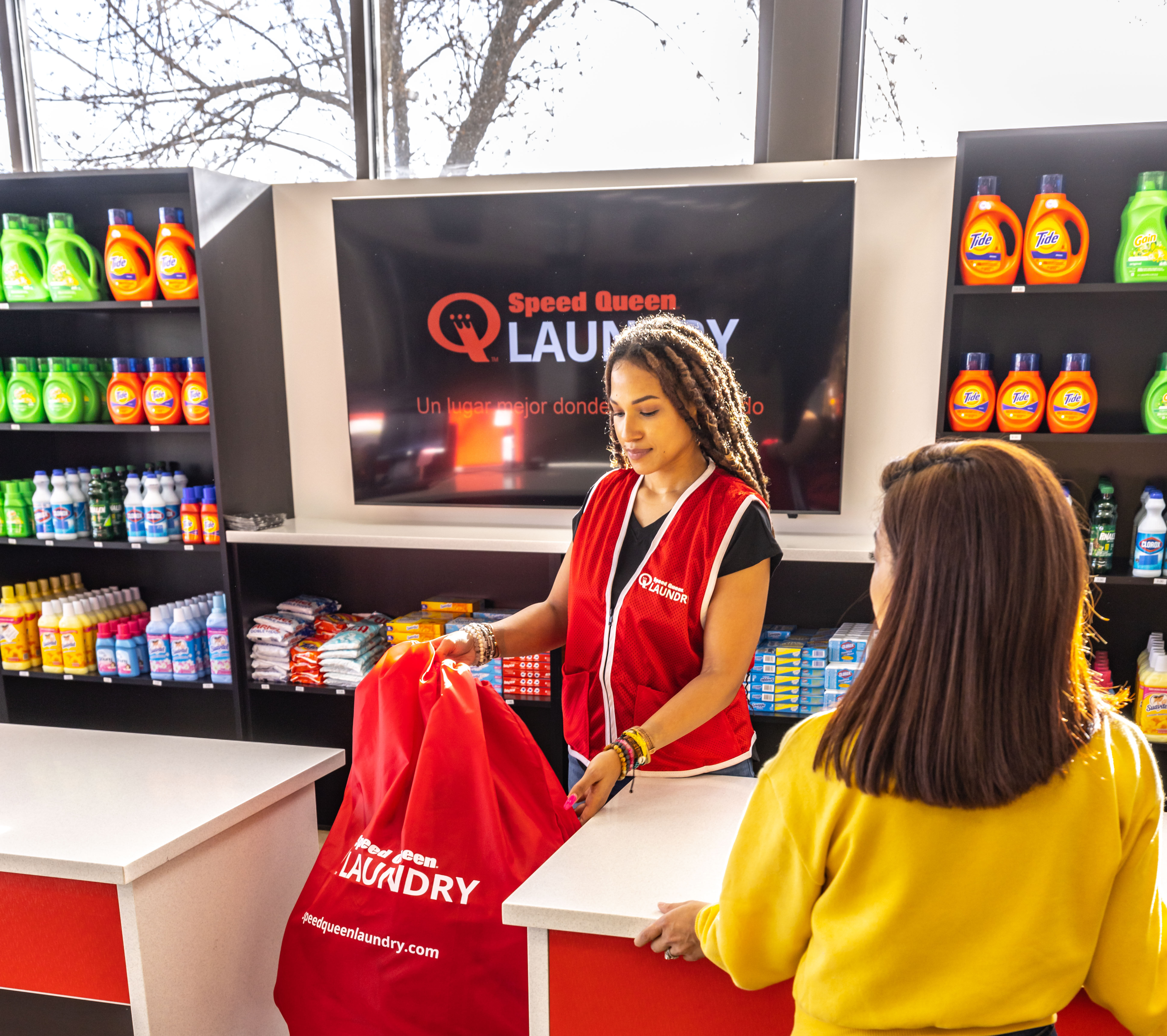
A wash, dry, fold service, sometimes just known as a wash-and-fold laundry service, means dropping off a bag of laundry (or scheduling a pickup) and getting it back washed, dried and folded without touching a machine yourself. Here’s what happens to your bag at Speed Queen Laundry, once it leaves your hands: At Speed Queen Laundry, your order is given a careful, step-by-step treatment:
- Weighed at the counter
- Separated by care instructions
- Washed with detergent and softener
- Dried completely
- Folded
Some locations offer same-day or next-day turnaround (depending on the store).
Where it tends to make sense:
- Weeks when there isn’t a spare hour or two to sit through wash and dry cycles.
- Bulkier loads like bedding, towels or a full week’s worth of workout clothes.
- Anyone who’d rather pay a bit more per pound than budget an evening around laundry.
Pricing is by weight, with comforters, blankets and pillows priced by size instead. Most services set a minimum order, usually between 15 and 20 pounds. Speed Queen Laundry’s minimum varies by service and store, so check the posted minimum before you drop off.
Wash, Dry & Go: The Middle Option
Here’s a hybrid option that many people don’t know about: Speed Queen Wash, Dry & Go. Drop off your laundry in a washable bag, and Speed Queen Laundry handles the washing and drying. You pick it up clean, dry and ready to fold at home.
Skip two hours of machine time but keep the one part of the laundry that’s fastest for you to do: folding. It’s for the person who doesn’t mind folding laundry while streaming their favorite movie or TV show but would rather not spend two hours in a laundromat to get there. For students looking for a practical middle ground between full services and self-service, this is a smart option.
Laundry Pickup and Delivery
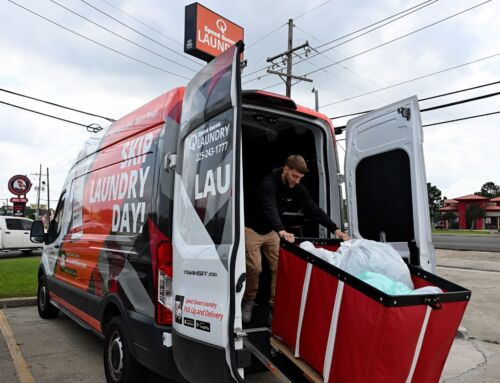
Laundry pickup and delivery takes the drop-off part out of the equation, too. At participating Speed Queen Laundry stores, you schedule a pickup in the app, leave the bag where you’ve arranged (like at a dorm front desk or building lobby) and get it back washed, dried and folded. You can often schedule a next-day turnaround and get texts or email updates along the way. The first time a bag of clean, folded laundry shows up during finals week, it feels a little like a care package you sent yourself.
Where it tends to make sense:
- No easy walk or ride to a laundromat, especially once the weather turns.
- A packed schedule where even a laundromat trip is hard to fit in.
- Setting up a recurring order, weekly or every other week, so laundry stops being a weekly decision.
Doing It Yourself at a Self-Serve Laundromat
When it works with your schedule, running the wash, dry and fold cycle yourself is often the best choice, and it’s a lot easier than the coin-fed version your parents may remember from their school days. Instead, pay from the app and get a notification when the cycle is done. You can also earn rewards, like credit towards free laundry with every self-serve load.
Where it tends to make sense:
- Keeping costs as low as possible.
- Not minding the time it takes, or treating it as a built-in study break with the best white noise on campus.
- Wanting full control over detergent, water temperature and how things get folded.
Tip: Choose the dryer by load size, not by whichever one is closest. Speed Queen Laundry guarantees a load will dry in one cycle, when the right size and settings are selected. Cramming a large load into a small dryer is how a 45-minute errand turns into a 90-minute one. Have sizing questions? Just ask an attendant and they should be able to guide you to the right equipment.
None of these need to be a permanent choice. Plenty of students mix and match depending on the week, self-service on lighter weeks, a wash-and-fold laundry service or pickup-and-delivery order when the schedule gets tight.
Chicago Weather and Your Laundry Schedule
Fall in Chicago is mild for a while, then it isn’t. In fact, the National Weather Service puts Chicago’s average at about 37 inches of snow a season, and the first measurable snow usually lands in mid-November, right as the semester heads into its final stretch. A laundry plan that feels easy in September can feel like a chore by Thanksgiving. And by finals, when time is tightest, a few blocks to the laundromat is suddenly a tough decision instead of an easy habit.
A few things to plan around as the seasons shift:
- Bulkier winter loads: Coats, sweaters and heavier bedding take up more machine space and often need extra drying time, so factor that into how much time or budget a load takes. A puffer coat or full comforter is a large-capacity-machine job, which is one place a laundromat beats out a dorm washer.
- Walking to a laundromat gets harder: A few blocks in October is a different errand in January, with wind coming off the lake. This is often when pickup and delivery starts looking more appealing to students who did self-service all fall.
- Laundry piles up faster in winter: Bulky outerwear and layers mean more items in rotation, so it might be worth doing smaller, more frequent loads rather than waiting for a full hamper.
- Road salt is the new enemy: Chicago streets get salted early and often, which is good news for drivers, but bad news for your jeans and coats. Rinse or wash salted items in cold water as soon as possible. Use a gentle cycle for down and puffer coats, then dry them on low with a couple of dryer balls (or tennis balls) to break up the clumps.
- Winter break: Wash everything before you leave. A damp towel or a half-done hamper in a closed room for three weeks comes back smelling pretty musty. If you’re heading out right after your last exam, a wash-and-fold drop-off on the way is an easy fix.
There’s no need to lock in one plan for the whole year. It’s reasonable to self-serve through the fall and switch to a wash-and-fold laundry service or pickup and delivery once the weather makes trips out less appealing. Whatever you choose, Speed Queen has four Chicago-area locations.
Frequently Asked Questions about Student Laundry Options
What should I bring to a self-serve laundromat the first time?
Detergent, a bag or basket that fits everything, a mesh bag for anything delicate and a way to pay (at Speed Queen Laundry, that can be the app on your phone). If you forget detergent, many laundromats sell it on-site, so it isn’t a dealbreaker. Bring something to do, too. A full trip is usually an hour to an hour and a half.
How do I know which machine size to use?
A good rule of thumb is that clothes should fill about three-quarters of the drum when loosely dropped in, with room to tumble. If you have to push things down to close the door, move up a size. Comforters, sleeping bags and a full set of sheets and towels belong in a large-capacity washer no matter how light they feel. When in doubt, ask the attendant, who can point you to the right machine for what you brought.
Does laundry pickup and delivery work at a dorm?
Usually, as long as there’s a spot to hand off the bag. Some residence halls let a front desk or mailroom hold it, while others want you to meet the driver outside, so check with your RA or building staff before the first order. If you live in an apartment, a lobby or a secure vestibule works the same way. Speed Queen Laundry offers pickup and delivery at participating Chicago stores, scheduled through the Speed Queen app.
Hot, warm or cold water?
Cold for almost everything. It’s gentler on fabric, keeps colors from fading and is what most care tags call for. Warm makes sense for towels, sheets and sweaty gym clothes. Hot is rarely needed. At self-service laundromats, the cycle you choose usually sets the temperature for you, so pick the cycle that matches the load and let the machine handle the rest.
Do laundromats have free Wi-Fi?
Speed Queen’s four Chicago-area locations all offer free Wi-Fi, so you can get homework done while you wait.
Can I leave while my laundry runs?
Yes, within reason. Turn on cycle notifications in the Speed Queen app so you know exactly when to come back, and plan to be there within a few minutes of the cycle ending. Leaving a finished load in a machine is the fastest way to have someone else move it. If you’d rather stay, Speed Queen’s four Chicago-area locations have free Wi-Fi, so it’s a decent place to knock out a reading assignment.
How often should I wash sheets, towels and gym clothes?
Follow the American Cleaning Institute’s guidance:
- Gym clothes should be laundered after every wear.
- Towels need to be cleaned every three to four uses. Be sure to hang them to dry fully between showers so they don’t get musty.
- Sheets should be cleaned every one to two weeks. Bedding is exactly the kind of bulky, low-effort load that a wash-and-fold drop-off handles well, if you’re short on time.
What if a machine doesn’t start or stops mid-cycle?
Don’t move your clothes to another machine and pay again. Note the machine number and tell the attendant first. At Speed Queen Laundry, there’s usually someone on-site who can restart the cycle or sort out the payment, and if you paid through the app, your account shows exactly what you paid and when.
Finding What Works for Your Semester
There’s no single correct way to do laundry as a college student, just the option that fits a given week best. Some weeks, that’s a trip to a self-serve laundromat. Others, it’s a wash-and-fold laundry service drop-off, or a laundry pickup and delivery order timed around a busy schedule or a snowy commute.
Find a Speed Queen location near your dorm or apartment and see what fits, then adjust as the semester and the Chicago weather change. And the next time the hamper is full the night before an exam, you’ll already know what to do.